Security experts have issued an urgent alert after discovering a massive database floating on the internet that contains 2 billion email addresses and 1.3 billion passwords, a recent report from cyber intelligence firm Synthient reveals.
Unlike a traditional breach of a single company, this leak is actually a large aggregation of credentials collected from thousands of smaller data leaks and malware infections. According to Troy Hunt - the founder of the well-known breach-check service Have I Been Pwned - the dump contains many new credentials that were never seen in previous leaks. This means even very careful users may have been unknowingly compromised.
🔍 How to Check If Your Password Was Leaked
Go to Have I Been Pwned and navigate to the Pwned Passwords page.
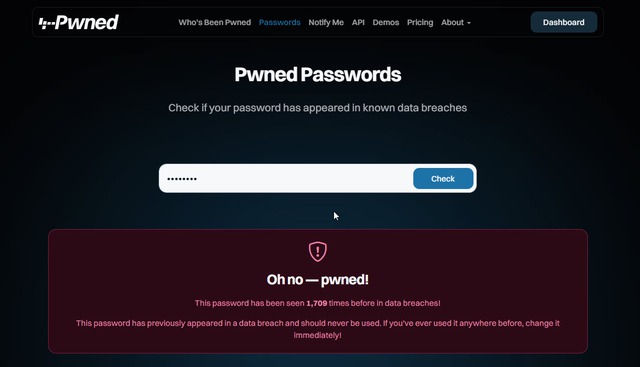
Enter the password you use most often. The system uses an anonymized algorithm and does not store your typed password.
If the result shows a red warning and gives a number, that means your password has been exposed.
If your password was found, change it immediately.
✅ Expert Security Recommendations
Cybersecurity experts who investigated the incident strongly suggest users take the following actions:
Don’t reuse passwords across different accounts. A single compromised password can put your other accounts at risk.
Enable Two-Factor Authentication (2FA) - this adds a critical extra layer of protection, even if someone knows your password.
Use passkeys instead of traditional passwords where possible. This newer technology removes the need to remember or store passwords.
Install reliable antivirus or anti-malware software to detect and block infostealers — malware that secretly steals your credentials.
This incident is a stark reminder that even aggregated “old” credentials still pose a serious threat — and everyone should proactively check and secure their accounts.
![[Latest News] FLI Alumni & Partners Monthly Engagement Series](https://vcystvqnqlquncjkhfqk.supabase.co/storage/v1/render/image/public/cm86yzxje006dqu90iz4rc2vg/cm99jkhp20069j9vubvs02vza/885128_image.jpeg?width=600&quality=80&resize=contain)
![[Expert View] THE WORKFORCE CHALLENGE IN THE DIGITAL AGE: AS TECHNOLOGY SHAPES THE FUTURE, MORE WOMEN NEED TO BE PART OF BUILDING IT](https://vcystvqnqlquncjkhfqk.supabase.co/storage/v1/render/image/public/cm86yzxje006dqu90iz4rc2vg/cm99jkhp20069j9vubvs02vza/680085_image.jpeg?width=600&quality=80&resize=contain)
![[Expert View] At which career stage are Vietnamese women “disappearing” in the tech sector?](https://vcystvqnqlquncjkhfqk.supabase.co/storage/v1/render/image/public/cm86yzxje006dqu90iz4rc2vg/Users/607147_image.jpeg?width=600&quality=80&resize=contain)
![[Latest News] HCMC offers $8 daily allowance for workers in national database campaigns](https://vcystvqnqlquncjkhfqk.supabase.co/storage/v1/render/image/public/cm86yzxje006dqu90iz4rc2vg/Users/591768_image.jpeg?width=600&quality=80&resize=contain)
![[Latest News] Vietnam leads Southeast Asia in using Google AI for education](https://vcystvqnqlquncjkhfqk.supabase.co/storage/v1/render/image/public/cm86yzxje006dqu90iz4rc2vg/Users/28731_image.jpeg?width=600&quality=80&resize=contain)
![[Event] Vietnam Women Tech Award 2026 - Award Categories](https://vcystvqnqlquncjkhfqk.supabase.co/storage/v1/render/image/public/cm86yzxje006dqu90iz4rc2vg/Users/37294_image.jpeg?width=600&quality=80&resize=contain)
![[Event] Meet-up Recap | Human + AI Agents Collaboration: How Organizations Can Build AI-Ready Teams and Operations](https://vcystvqnqlquncjkhfqk.supabase.co/storage/v1/render/image/public/cm86yzxje006dqu90iz4rc2vg/Users/963421_image.jpeg?width=600&quality=80&resize=contain)
![[Latest News] Vietnam has highest rate of elite AI professionals in Southeast Asia](https://vcystvqnqlquncjkhfqk.supabase.co/storage/v1/render/image/public/cm86yzxje006dqu90iz4rc2vg/Users/927752_image.jpeg?width=600&quality=80&resize=contain)
![[Event] VIETNAM WOMEN TECH AWARD 2026 - AWARD CATEGORIES](https://vcystvqnqlquncjkhfqk.supabase.co/storage/v1/render/image/public/cm86yzxje006dqu90iz4rc2vg/Users/795901_image.jpeg?width=600&quality=80&resize=contain)
![[Event] Official Launch of Vietnam Women Tech Award 2026](https://vcystvqnqlquncjkhfqk.supabase.co/storage/v1/render/image/public/cm86yzxje006dqu90iz4rc2vg/Users/153052_image.jpeg?width=600&quality=80&resize=contain)